The Myth of the Unchanging Tradition
The myth of the unchanging tradition can make adaptation feel like loss. Learn how to distinguish meaningful continuity from details a community can change.
Must a tradition look exactly as it did in your grandparents’ time to remain meaningful? The myth of the unchanging tradition can make a new song, a different gathering place or an altered ceremony feel like a break with the past. Yet customs are not museum pieces: people inherit them, practise them and sometimes reshape them to meet lives their predecessors could not have imagined.
Change is not automatically harmless, and preserving a form is not automatically narrow-minded. A custom can carry faith, memory, identity or obligations that its participants do not want altered. The question is not whether anything has changed, but what the change means to the people who carry the tradition—and who gets to decide.
How traditions are made
A tradition may feel ancient without having existed in precisely the same form across every generation. A family might remember a seasonal gathering through a particular story, while the place, language or food has shifted as relatives moved. What persists may be a shared act of remembrance rather than a fixed set of details.
That does not mean every custom is open to revision. A prayer, ceremonial garment or sequence of actions may have a significance that participants believe depends on its established form. In other settings, the purpose may be more adaptable: welcoming newcomers, marking a transition or passing on a community’s history.
Instead of assuming that visible details are either sacred or trivial, ask participants how they understand them. A garment may be decorative to one observer and central to a community’s identity; an unfamiliar gesture may carry a meaning outsiders cannot see. Listening is more useful than deciding from appearance alone.
Preservation and change
Some people deliberately preserve a custom’s established form. This can keep a clear link with earlier generations or honour rules that participants regard as essential. Preservation need not freeze every practical detail: a ceremony may keep its sequence while invitations move from spoken announcements to letters or messages.
Other communities alter a practice because circumstances have changed. An event might move when its former venue is no longer accessible, or a gathering might include people who could not previously take part. An adaptation is more likely to feel like continuity when those affected shape it and can explain what they want to retain.
Sometimes several versions coexist. Relatives in different places may tell the same family story in different languages, or mark an occasion with local music while recognising a shared connection. That arrangement can be welcoming, but it should not be imposed where participants or a recognised authority require a particular form.
Deciding what changes?
Who has a say in changing a tradition?
People who practise and carry the custom should have a meaningful voice, including those with less formal authority. Organisers and outside observers may contribute, but they should not decide on behalf of participants whose lives or beliefs are at stake.
Does adaptation make a custom less authentic?
Not necessarily. For some people, authenticity means following a prescribed form; for others, it means maintaining an honest connection to a shared history or purpose. The people involved are best placed to describe what that connection requires.
Can different versions belong to one tradition?
They can if participants recognise the relationship and are comfortable with the differences. If they do not, it may be clearer to describe a newer practice as a distinct custom rather than claim a shared identity for it.
When should a detail stay unchanged?
If participants say that a detail is essential to the custom’s religious, cultural or personal meaning, changing it may alter the practice itself. Where the tradition has a recognised authority, seek its guidance rather than assuming a practical substitute is acceptable.
A considered choice
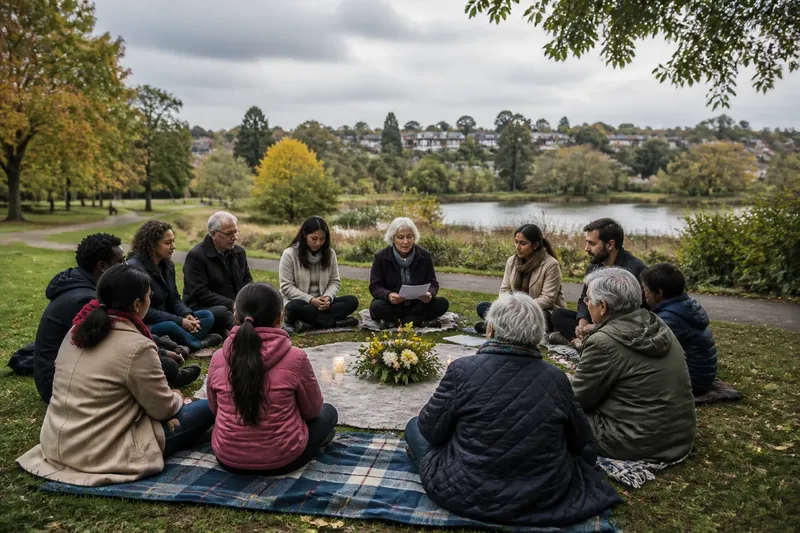
Imagine a family that has held an annual remembrance in a village hall, but a move means several relatives can no longer travel there. The family asks those who attend what matters most: some name the shared reading, while others value the walk afterwards. They agree to meet in a nearby park, keep the reading, and invite anyone unable to travel to share a memory by letter; the observable result is that the familiar words and personal contributions remain part of the gathering, though its setting and participation have changed.
The decision need not be settled by a quick vote between “old” and “new”. Ask who takes part, who carries responsibility, which elements participants consider essential, and what difficulty the proposed change addresses. A change made mainly for the convenience of the most powerful organiser may land differently from one shaped by the people most affected.
- Purpose: If participants can name a shared purpose, then use it to guide decisions; if they disagree, then discuss the difference before changing the practice.
- Essential elements: If people identify an action, word or object as central, then preserve it; if no shared view emerges, then pause and ask what each interpretation means.
- Practical pressure: If a venue, material or schedule excludes participants, then consider an accessible alternative; if it creates no real obstacle, then do not change it merely for novelty.
- Decision-making: If those most affected are represented, then invite their consent and views; if they are missing, then postpone a decision and make space for them to speak.
- Explanation: If the group agrees on an adaptation, then explain what changes and what remains; if participants cannot describe the distinction, then clarify it before presenting the new form.
- Review: If the change serves its stated purpose, then continue it as agreed; if it causes an unexpected loss or exclusion, then revisit the choice with participants.
Continuity without sameness
It is rarely worth debating an incidental detail just to prove that a custom has changed, or preserving a detail nobody values solely because it looks old. Attention is better spent on what participants say connects them to one another and to earlier generations.
The myth of the unchanging tradition offers a tidy test: repeat the form and the past stays close. In practice, customs may be carefully preserved, adapted or carried in several local versions. The myth of the unchanging tradition is less useful than a more grounded question: can the people who practise a custom recognise its meaning in what they choose to carry forward?